Can a DNA removable appliance treat obstructive sleep apnea in children?
Over the past few years, I have raised questions about the effectiveness of orthodontic treatment for paediatric obstructive sleep apnoea. This reflected my concern about the limited evidence supporting this type of treatment, along with what seems to be a noticeable rise in the provision of “airway orthodontics”. I was, therefore, very interested in this new study, which was a multicentre prospective clinical trial conducted in the USA and Canada.
A team from Stanford University led the study. The European Journal of Paediatrics published the paper.

Clete A. Kushida et al.
European Journal of Pediatrics. https://doi.org/10.1007/s00431-025-06254-x
The authors disclosed several conflicts of interest related to this publication. Vivos Therapeutics Incorporated funded the study. This company produces devices for treating obstructive sleep apnoea. The lead author receives fees and stock options for serving as chair of the company’s medical advisory board. Two other authors receive fees from Vivos for sponsor training and educational activities, while two authors were paid by the company that acted as the regulatory consultant for the study’s sponsor.
What did they ask?
They did this study to;
“Evaluate the safety and efficacy of a slow maxillary expansion with the Day Nighttime Appliance (DNA appliance) in children with obstructive sleep apnoea”.
What did they do?
They did a non-randomised interventional pre–post study design. Each participant served as their own control, with measurements taken before and after treatment.
The DNA appliance is a removable device that can expand the arches both anteroposteriorly and transversely. The expansion screw is turned to achieve .25 mm expansion, usually once a week and at least once a month.
I’ve included a screenshot of the appliance here, as this is an open-access publication. If you want further details, you can easily access this paper.
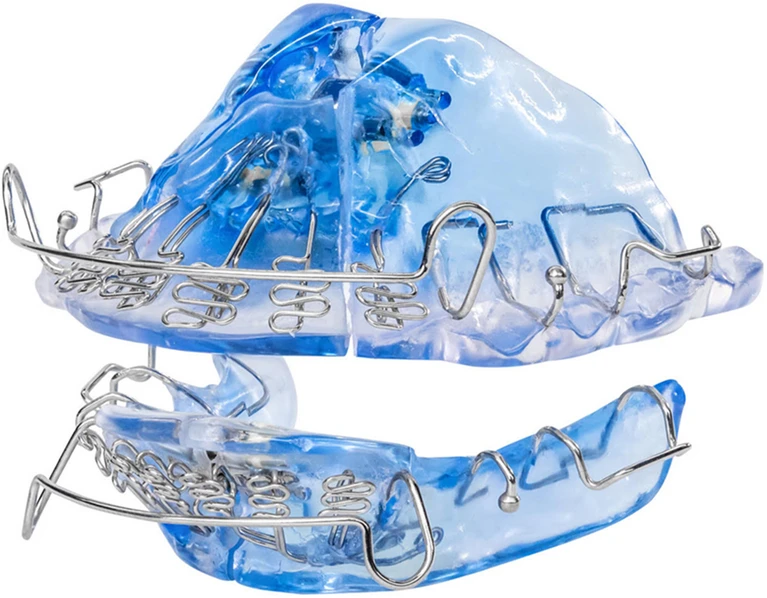
I also obtained this information from an AI overview of this appliance.
“A DNA appliance is a custom-made, removable orthodontic device used to gradually correct and reshape the craniofacial structures of children, teens, and adults. It functions as a retainer, bite splint, and palatal expander to increase the volume of the nasal and oral airways, which can help with issues like sleep apnea, snoring, and TMJ pain. The treatment is based on the concept of “Pneumopedics,” which involves non-surgically increasing the size of the upper jaw”.
I looked for publications; the most recent one I found was this retrospective study, published by a similar team in a predatory journal in 2023.
I managed to find some information on the cost of the treatment. This was between $8,000 and $12,000.
Study design
The PICO for the study was.
Participants
Patients who are aged less than 18 years in the permanent or mixed dentition with a diagnosis of sleep disorder breathing (AHI less than or greater than 1).
Intervention.
The DNA appliance.
Outcomes.
They identified three primary outcomes.
- The total score on the paediatric sleep questionnaire (PQ)
- Sleep study-derived apnea-hypopnea index (AHI). This was recorded using a home sleep apneoa test at an AASM-accredited sleep centre.
- Intermolar width measured from the study casts.
Secondary outcomes
Sleep-related breathing disorders, airway volume measurements from CBCT images, and the amount of time participants wore their removable appliance.
The treatment was carried out by a dentist in five sites.
They collected data at the start and end of treatment.
The treatment was considered complete when there was space for mandibular and maxillary incisor alignment, subjective improvement in sleep quality and daytime fatigue as measured by the PSQ, and objective improvement in airway volume.
They conducted a sample size calculation that suggested they needed 40 participants for the study. They performed the relevant before-and-after data analysis.
What did they find?
They enrolled 55 participants in the study. Seven participants dropped out, and 48 participants completed the trial. The mean age of the participants was 10.5 (SD = 2.37) years at the start of the study.
They produced a large amount of data, and I’m only going to concentrate on the primary outcomes. I have put the most important results in this table. These differences are all statistically significant.i
| Outcome measure | Pre-treatment | Post-treatment | Difference | 95% CI | % change |
| PSQ | 0.28±0.135 | 0.14±0.104 | −0.13±0.019 | −0.17, −0.09 | 31.0 |
| AHI | 9.13±6.655 | 4.31±4.614 | −3.47±1.015 | −5.52, −1.42 | 29.3% |
| Intermolar width | 32.18±3.457 | 36.23±3.64 | 4.03±0.421 | 3.18, 4.88 | 13.0% |
Importantly, there are no reports of safety issues. The team’s conclusion was
“Slow maxillary expansion by the DNA device was safe and effective for treating children with OSA and the symptoms of sleep disordered breathing”.
What did I think?
I have carefully reviewed this paper because it was one of the first studies on the use of a removable appliance to treat OSA.
The authors took a conventional approach and noted that adenotonsillectomy is the primary treatment for paediatric OSA with tonsillar and adenoidal enlargement. If this is not successful, they suggest that second-line treatment is positive airway pressure (PAP). They also state that RME is indicated for children with a narrow palate. This is not always the message we get from our group of “airway-friendly” orthodontists.
The authors also highlighted the limitations of their study. Some were related to measurement methods, which they addressed effectively.
Nevertheless, the most significant limitation was their choice of a non-randomised pre- and post-treatment study. This means that the study lacked an untreated control group, and the changes could have occurred simply due to growth.
This could have been addressed by adopting an RCT design with an untreated control group. However, the authors point out that this would not be ethical because they would not be in equipoise.
I am uncertain about this because, if we are unsure whether a treatment is effective, it is ethical to enrol an untreated group. This is undoubtedly the case with orthodontic treatment for OSA. This approach was indeed the one we took in the early Class II treatment studies many years ago, and we enrolled children in a delayed-treatment group.
It is also good to see that the authors were completely transparent about the funding source for their project and any conflicts of interest. This is the usual process in other company-funded medical studies.
Final comments.
This is an interesting study. However, it does not distinguish between the possible effects of the appliance and normal growth changes. Consequently, I do not agree with their conclusions that the treatment is effective.
My other concern is with the DNA appliance. When we conduct a study, we should consider the rationale behind the treatment we are testing. I may be missing something here, but the appliance is an upper and lower removable device that tips teeth. As a result, I cannot see any theoretical basis for this treatment influencing the airway. Perhaps an airway expert can explain this to me, but I simply do not understand how this appliance is supposed to “work”.
This post may be rather controversial. Let’s have a good discussion about this in the comments section of my blog.

Emeritus Professor of Orthodontics, University of Manchester, UK.
Cost of treatment like this over here more like 800$………
Here is what the public will find using Google AI Mode regarding the so-called “DNA” appliance:
The DNA (Daytime Nighttime Appliance) appliance works by applying gentle pressure to stimulate the natural growth of the jaw and widen the upper palate, which in turn expands the airway. It is a non-invasive and non-surgical orthopedic and orthodontic device that encourages the body to develop an open airway, correct jaw alignment for breathing, and alleviate symptoms of sleep apnea, snoring, and TMJ disorders.
How it works
Stimulates bone growth: The appliance is designed to stimulate the bones in the face to promote natural growth, especially in the upper jaw.
Expands the palate: By expanding the upper palate (the roof of the mouth), the appliance increases the volume of the mouth and airway.
Repositions the jaw: It encourages the lower jaw to move forward, which improves the relationship between the upper and lower jaws and helps correct issues like those that cause sleep apnea and TMJ pain.
Improves breathing: The expanded airway reduces blockages and helps people breathe more easily, both day and night.
Trains the tongue: It helps train the tongue to rest in the correct position to prevent it from blocking the airway during sleep.
Treatment details
Wearing schedule: Patients wear the appliance for 10-16 hours a day, typically including while sleeping.
Adjustments: The appliance can be adjusted at home approximately every two weeks for adults, with professional check-ups every few months.
Duration: The total treatment time usually ranges from 12 to 24 months.
Aesthetics: It can lead to cosmetic benefits by improving facial structure and creating more room for teeth, often without the need for permanent braces.
AND MORE IMPORTANTLY THEY CLAIM THE FOLLOWING:
The DNA appliance affects genetics through a process called epigenetic orthodontics, which modulates the expression of the patient’s own genes to improve craniofacial development, rather than altering the genes themselves. It works by activating the body’s natural genetic potential to remodel bone in the face and jaw, which can correct underdeveloped structures, improve the airway, and address issues like TMJ dysfunction, sleep apnea, and crowded teeth.
How the DNA appliance works:
Epigenetic orthodontics: The appliance uses principles of epigenetics to “upregulate” or “modulate” the expression of the patient’s naturally occurring genes. This means it encourages the body to follow its optimal genetic blueprint for development without using invasive surgery or altering the genes themselves.
Bone remodeling: By stimulating immature or embryonic cells, the appliance encourages the bones of the face and jaw to remodel over time, correcting underdevelopment. This is achieved through gentle expansion rather than the physical force of braces.
Tissue and airway enhancement: This bone remodeling has a domino effect, leading to a more optimal alignment of the teeth, a healthier airway, and improved jaw position.
Mimicking ideal development: The process is described as biomimetic, as it uses biological means to achieve a result that mimics what would have developed in an ideal environment.
What this means for genetics:
Not gene modification: The DNA appliance does not involve gene transfer or artificial genes.
Gene expression: It influences how existing genes are used. The appliance acts like a “conductor” for the “orchestra” of your genes, telling them how to play to produce a desired outcome, much like how environmental factors can influence gene expression.
Activating potential: It helps a patient achieve their full genetic potential for healthy development, correcting issues that may have resulted from factors like thumb sucking, pacifier use, or mouth breathing.
Benefits of this approach:
Non-surgical and minimally invasive
Corrects issues related to TMJ dysfunction and sleep apnea
Can improve facial aesthetics by providing support for the upper lip and creating a more prominent jawline
Can help align crowded teeth by creating more room in the dental arches
SO…A removable Swartz expander with finger springs can do all the above? Fascinating, that……. there is still swamp land available in Florida.
https://nypost.com/2025/12/01/health/parents-spending-thousands-on-orthodontic-trend-for-their-tweens/
just “expanditall” SAVE LIVES. MAKE MONEY.
Jay:
Don’t be such a kneejerk iconoclast! Just because new information does not align with objective reality doesn’t mean you can’t embrace alternative orthodontic facts.
(Don’t you wish there was a “Sarcasm” font…)
Your Angle friend,
Tom Fischer
Thanks Tom. Kneejerk is an appropriate appellation! My comments were certainly “tongue-in-cheek” and therefore probably would benefit from a little snip and some tongue training.
Alternative fact patterns abound especially when there is no objective criticism ever leveled.
“Those who can make you believe absurdities can make you commit atrocities” -Voltaire.
Hope to see you soon,
Jay
If nothing else this looks like an appliance that you and I Kevin would have been asked to fabricate in the 1980’s on an ortho postgrad program!
Makes aligners look good, and, as you mention is unlikely to have any skeletal effect on a structure that is attached to the cranial base!
Maybe it makes orthodontic technicians happy – I can’t see who else.
The new alchemy! Turning children’s teeth into gold.
These “Airway friendly” appliances and practitioners seem like weeds in a garden. Pull one out and two more grow in.
What our specialty needs are a few good weeding sessions, where these unproven and often harmful (yes this appliance is harmful) claims are thoroughly weeded out totally and completely. This needs done out in the open, before the public, so this is exposed for what it is. If our specialty stands together, firmly and publicly, there will be no incentive for them to mislead the public, as the public will be aware. We wouldn’t need to self police, a job we are failing at, as the public would do it for us.
Like a good thorough weeding of the garden, we then will only have a little work keeping it up. Right now we have a garden overgrown with weeds, and the problem is getting worse.
While the AAO white paper was an excellent step in the right direction, it is now apparent that it was not sufficient. This is because the audience for the the AAO white paper was us, not the public. It’s intent was to guide us in how we are to ethically treat out patients. As it was internal, within our specialty, there was no disincentive for those who wished to ignore it and to continue down this wrong road. There is no downside for those practitioners who ignore it, currently the situation is quite the opposite.
While a step in the right direction, with so many willing to flout its logic and guidance, it alone is insufficient.
IMO what is needed now are official statements specifically intended for the public. This is so that they can do what we ourselves have so far failed to do, reign in our opportunistic and nefarious fringe.
Official news releases, official statements and interviews with TV and print media outlets would be a start. Providers pushing unproven and sometimes harmful (think AGGA and the FDA fines and class action lawsuits it caused) is news that will carry without costing the AAO advertising dollars.
Remember when 20:20 did a piece on unsterilized dental handpieces? That one news feature changed the habits of an entire profession.
Of course, not allowing this unscientific fringe to speak at AAO and affiliate meetings should be an immediate step.
This craziness has gone on too long. We need to weed this overgrown garden, or too soon all we will have are weeds. Thanks for listening. 😉
Thanks for posting this, Kevin:
I am the inventor of the DNA appliance system and the Founder of Vivos, which is the company that sells the device after it acquired its rights, title and interest about 5 years ago. I am no longer associated with the company, but would like to add a few facts/clarifications:
• The DNA appliance system is FDA cleared in the US for the treatment of mild, moderate and severe OSA in both adults and children.
• The effects in the study may be due to growth, but you quote the study by Dao et al., which was done in adults. The findings of that study were preceded by a similar study also in adults by Katz et al. Use of the complete airway repositioning and expansion (CARE) approach in 220 patients with obstructive sleep apnea (OSA). Sleep Med. 2022;99:18 – so I’m not sure I follow your rationale.
• Regarding a removable Swartz (sic) expander with finger springs: That’s how the work began. The late orthodontist, Jim Krumholtz, treated approx. 500 adults using a Schwarz expander. I was able to show, using geometric morphometrics, that there was a beneficial effect on the upper airway similar to that found in children. These results are available in the book we co-authored (Epigenetic orthodontics in adults). However, it was not until the addition of my patented 3D axial springs that the DNA appliance system was born. The results of that technology, which I coined “Pneumopedics”, are to be found in the second book I wrote titled “Pneumopedics and Craniofacial Epigenetics”. After I presented my work at the World Sleep Society 2015, Professors in Sleep Medicine at Stanford University, USA took an interest in my original work and the task of further research.
• Regarding mechanisms, please read;
Banes et al. Mechanical forces and signaling in connective tissue cells. Current Opinion in Orthopaedics. 2001;12(5):389-396.
Roberts WE, Hartsfield JK. Bone development and function: genetic and environmental mechanisms. Seminars Orthod 2004;10(2),100-122
Singh GD, Battle J. Integrative treatment of obstructive sleep apnea: principles and practice. J Clin Sleep Med. 2025;21(9):1591-1596.
This paper was selected by the American Academy of Sleep Medicine for Continuing Medical Education in the US.
Singh GD. Maxillary appliances for the treatment of moderate obstructive sleep apnea: Adjustability and mechanisms. Trials 2025 (accepted, in press).
Sorry, Swartz (sic) is wrong. Is it Schwarz or Schwartz? Now, here’s the answer: The Schwarz expander (or appliance) was invented by Dr. Artur Martin Schwarz (1887–1963) of Vienna, Austria, who developed the appliance in 1956.
In any event, adding “patented” finger springs to it is hardly novel, especially with all the wild claims and coined terms it’s been wrapped in. So, the device didn’t work until the incisors were tipped forward with the “3D” springs, and that created the airway superiority?? Curious, that. Then if that works then a fixed quad helix and brackets with perhaps coil springs to tip incisors labially would maybe work better or more predictably, eh? Besides, science-sounding Pneumodontics seems like more hot air. Reminds one that Orthotropic was defined in medicine as “ascending into the gastrointestinal tract” before it ever sadly got “coined” into orthodontics.
FDA cleared it for airway? But, who is diagnosing and prescribing such a treatment? A physician needs to be somewhere in the mix. I find it difficult to imagine an ENT is going to jump on board to prescribe such a thing for folks with apnea, but that’s just me thinkin’.
Getting a patent can be done on almost anything and proves nothing, especially if the Claims (the meat of a patent) infringe upon another patent. We can, however, make-up cool names for TM’s, too, especially since evidence is scarce – controversy is license, controversy sells, and business is seemingly getting gooder (when no evidence is required to support claims on “professional” websites). But, perhaps NOT benefitting the public.
“FDA cleared” means a medical device has been shown to be “substantially equivalent” to a device already on the market, and its safety and effectiveness meet the criteria for its classification. This is a common pathway for low to medium-risk devices (Class I and II) and is obtained through a Premarket Notification (510(k)) process. It indicates the device has met basic safety and quality standards BUT DOES NOT MEAN it has been APPROVED as a new medical product like a drug.
DNA is still just a simple, removable, plastic expander that is not “growing bone,” is completely dependent upon patient compliance, and is absolutely not as effective in palatal expansion as other fixed devices. But the real question, still to be answered, is all of this “airway-friendly” obsession worth it in the long run? Especially for 3 year old tykes getting 4 mini-screws to fix expanders (screwed into their palates) when watchful waiting has thus far been as effective. Have patient obesity, T&A, and other factors been considered by a physician prior to carving-up tongues and wasting patient patience, tolerance, insurance, and subjecting them to pain for minimal gain?
Jay:
Thanks for your comprehensive reply, which unfortunately contains numerous errors that I will attempt to correct, while avoiding derisive/derogatory comments like a blue-assed fly, as follows;
“In any event, adding “patented” finger springs to it is hardly novel, especially with all the wild claims and coined terms it’s been wrapped in.”
• Historically, orthodontic finger springs were used to tip teeth. However, the 3D axial springs do not make single point contact with the teeth. Perhaps you’re unfamiliar with the design? In addition, the material of these springs is not SS and so the response is ostensibly not the same. Some dilettantes might see ‘tipping’ but those with an appreciation of the curves of Wilson, Spee and Monson understand that development compensation is (partially) corrected by decompensation (commonly described as ‘tipping’ by some). Craniofacial orthodontists working in craniofacial-cleft-palate teams are also familiar with orthodontic decompensation prior to orthognathic correction.
“So, the device didn’t work until the incisors were tipped forward with the “3D” springs, and that created the airway superiority??”
• In the diagnostic phase, the inclination of the incisors is measured with respect to the cranial base phenotype. Retroclined upper and lower incisors are a sign of development compensation, which encroach upon tongue space. Consequently, the tongue is often displaced posteriorly and may precipitate retroglossal upper airway compromise. Therefore, various retroglossal airway parameters are measured in the diagnostic phase. Studies on tongue crenation/scalloping are available in the sleep medicine literature.
“Then if that works then a fixed quad helix and brackets with perhaps coil springs to tip incisors labially would maybe work better or more predictably, eh?”
• Possibly, but I guess a study will be needed to support your conjecture. Put up or shut up. However, I included the findings of these types of studies in my two books on the topic, and the results do not support your speculation. For example, please see; Bavani et al. Rapid maxillary expansion and its impact on sleep apnea in children aged 5 to 8 years: a retrospective study. Dental Press J Orthod. 2025. And, as a Professor of Orthodontics, I supervised the PhD of an orthodontic resident. The sleep studies were done in conjunction with our ENT colleagues and published in J Oral Rehab. 2009, which showed concentric collapse of the maxilla in OSA, which is epigenetic in nature, emphasizing the clinical need for antero-posterior decompensation/development.
“Besides, science-sounding Pneumodontics seems like more hot air.”
• You must be confused. If Orthodontics is moving teeth, and Orthopedics is remodeling bone, then logically Pneumopedics is remodeling the airway (as shown in ENT studies). On the other hand, I have no idea what you mean by “Pneumodontics”.
“DNA is still just a simple, removable, plastic expander that is not “growing bone,” is completely dependent upon patient compliance, and is absolutely not as effective in palatal expansion as other fixed devices.”
• This is completely untrue. Please show me the studies/data where the DNA appliance has been compared to other fixed devices. It seems like you’re unfamiliar with its design, materials and protocol. Please read some studies/books on this specific topic.
“But the real question, still to be answered, is all of this “airway-friendly” obsession worth it in the long run? Especially for 3 year old tykes getting 4 mini-screws to fix expanders (screwed into their palates) when watchful waiting has thus far been as effective. Have patient obesity, T&A, and other factors been considered by a physician prior to carving-up tongues and wasting patient patience, tolerance, insurance, and subjecting them to pain for minimal gain?”
• Please see; Singh GD, Battle J. Integrative treatment of obstructive sleep apnea: principles and practice. J Clin Sleep Med. 2025.
The real answer, Jay, is that cynical, emotional generalizations are unscientific and frankly worrisome.
Appreciate the balanced treatment of this paper. The lack of control group is the salient point, as you point out. Also the timepoint of the post-expansion airway measurements. My hypothesis would be if you keep measuring treated and untreated cohorts they would end up equal after X years.
I know GP’s who now make a great living peddling this modality and others like it. Even pedodontists. Can cost upwards of 4-5K USD, and brainwash parents into thinking conventional orthodontics can be avoided after using this.
Thanks Dr. O’Brien
Hi Dr Lamichane:
I believe your ‘hypothesis’ is not supported by research done by Schendel et al. at Stanford University, USA.
And, what you mean by “brainwash parents into thinking conventional orthodontics can be avoided after using this”?
I’m not sure what country you’re in but the DNA appliance system is FDA cleared as a Medical device for the treatment of a Medical condition after diagnosis by a Medical professional and generically covered by Medical insurance (in the US). That does not preclude Dental treatment of a Dental condition after diagnosis by a Dental professional covered by Dental insurance (in the US), such as orthodontic treatment.
Hope that helps clarify any confusion –
Hi Kevin,
I’m a french orthodontist, very interested in sleep apnea in children. I’m going to retire soon but before, I’m writing a presentation which will be accepted in “la revue d’ODF”.(I hope)
I explain how I treat these children. I never use expanders, but self ligaturing treatement which is able to give the same results than expanders but with a single motor, the patient’s tongue. This treatement gives to the tongue an upper position, so it’s don’t fall into the throat and enhance the sleep apnea treatement.
In this presentation I relate a ten cases series.
I’ll be glad to send you this article when it’s be ready.
Are you agree?
Special regards
Emmanuel THELLIEZ With apologies for my english!