An interesting debate on airway orthodontics.
One of the most controversial areas in orthodontics is the role of the orthodontist in managing childhood airway problems. Currently, there are diverse opinions between those who promote “airway-focused” orthodontics and those who adopt a more evidence-based approach to this problem.
At present, there does not seem to be a solution to this, as good-quality research is lacking. I have posted about this many times before and sometimes wonder whether I am a lone voice in the wilderness, challenging the airway orthodontists. As a result, I was very interested to see this online podcast discussion that took place a few days ago.
Kyle Fagala, who runs the Digital Orthodontist Facebook group organised the podcast. I have listened carefully to the discussion and will try to put forward my perspective.
The podcast
Firstly, I would like to acknowledge the effort Dr Fagala put into producing this. I feel he took a bold step by inviting several proponents of airway orthodontics to discuss this with others who have been advocating for the approach to become more evidence-based. I would also like to point out that he did a very good job as moderator under difficult circumstances. If you want to view the podcast, it is here on YouTube.
The panel
He invited several orthodontists to take part in the discussion.
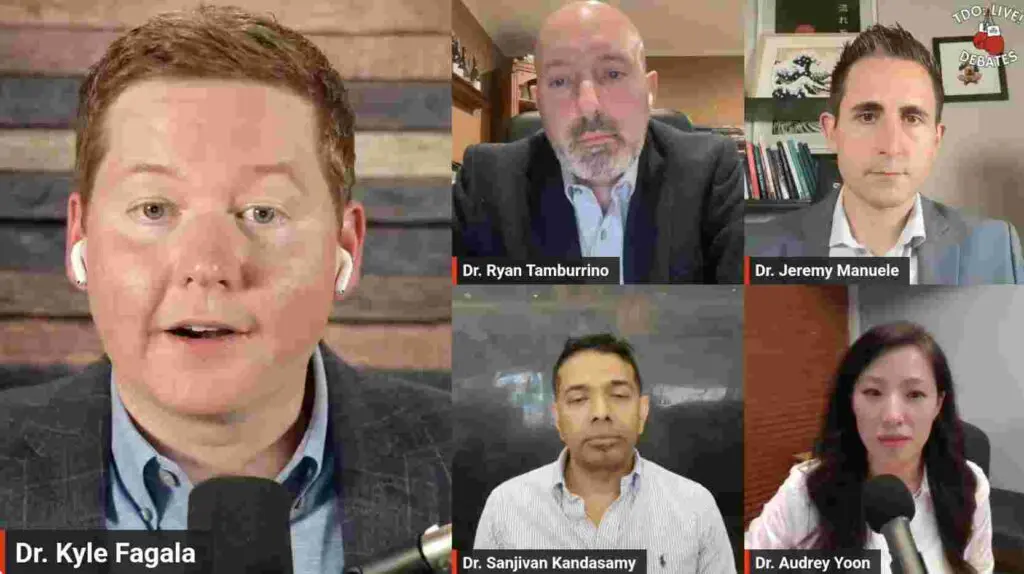
They were:
- Sanj Kandasamy. He is Clinical Associate Professor at the University of Western Australia and in private practice. He has written two excellent articles in the AJO on airway orthodontics (add link)
- Ryan Tamburrino he is in orthodontic practice in Pennsylvania, USA
- Jeremy Manuele who is in practice in Las Vegas, USA.
- Audrey Yoon, Clinical Professor at Stanford University and in private practice.
The podcast is available on the Digital Orthodontist Facebook page and on YouTube.
The podcast lasted 1 hour and 40 minutes. It is rather difficult for me to condense everything, as they addressed many complex issues. As a result, I will summarise the most important points and give my overall impression.
What does airway orthodontics mean?
This was the first question, really just an icebreaker. Audrey Yoon felt that airway orthodontics wasn’t a specialty; it was more a treatment-planning philosophy. She pointed out that routine planning should not be limited to tooth alignment and that we should also evaluate growth potential, etc. (I thought all orthodontists did this).
Sanj Kandasamy was a little more forthright and felt it had become a selling point, used for marketing by orthodontists and dentists. Ryan Tamburrino felt that a better term for us to consider was “an orthodontist involved in dental sleep medicine.”
AAO White Paper
We then moved on to discuss the AAO White Paper on Orthodontics and Sleep-Disordered Breathing. The discussion became a little confusing because Audrey Yoon seemed more concerned about an attorney being on the paper’s author list than about the content. Sanj Kandasamy felt that the current situation was similar to that of Gnathology and the TMD debate in the 1980s, and that this time the AAO was getting on the front foot in the airway controversy. Audrey Yoon felt that the paper served as a risk-management tool and was written in response to the current controversy. Ryan Tamburrino felt that this was a very good middle-of-the-road starting point for discussion.
The disconnect between medical and orthodontic research on airway.
This was a long and complex discussion. I will not go through their individual responses, but i noted these major points.
A general theme was that airway problems are multifactorial, so research may not necessarily give us an answer. This is why there is currently no high-level research in this area.
The airway proponents then led a discussion on outcome measures. They suggested that AHI may not be a suitable outcome measure. Neither was CBCT diagnostic of sleep issues. They also cited three papers produced at Stanford University in support of their philosophy. I have examined these closely, and they are flawed because they are cohort studies of expansion and they did not include a control group. As a result, any changes observed will have included normal facial growth.
The level of evidence in the discussion began to sink to new lows from this point onward.
Importantly, most of the discussion they use to promote airway orthodontics appears to be based on low-quality evidence. I also thought that this discussion was very similar to others I have had over the past 40 years with “fringe” orthodontists, who simply list a large number of papers or state that there is a lot of research, but do not necessarily refer to the papers or even consider that they are not high-level studies. I’m not sure whether this is a tactic to simply bury people in a white “noise of nonsense” or a simple misunderstanding on their part of what constitutes research.
The only voice of reason in this part of the discussion was Dr Sanj Kandasamy, who had a good grasp of the current literature.
Does expansion improve the airway?
This was another lengthy area of discussion. Dr Kandasamy stated that expansion does affect the nasal airway, with significant variation. Neverthless, we must remember that tonsillectomy is the first-line treatment.
This then led to a discussion about when to expand. Dr Manuele and Dr Yoon felt that we should identify the need for expansion within the overall aim of achieving an ideal relationship between the upper and lower jaws. They cited evidence from studies of skeletal remains from 500 years ago, suggesting that we should treat our patients according to the norms of that time. This was the argument put forward by the now discredited proponents of orthotropics.

This led to the proposal that we should consider expanding the maxilla by 3-5mm, even if there is no crossbite.
They also suggested that we should start this treatment now to prevent problems in 40 years’ time. They recommended that we place the lower teeth upright on the basal bone for airway and periodontal health. I have not come across this concept before.
It was also not lost on me that the proposed standard for orthodontic treatment is CBCT for every patient to detect transverse discrepancies that other methods cannot.
In summary, this section of the podcast became a wall of confusing white noise, lacking quality research. Instead, it appeared to be based upon information from low-quality studies and clinical experience.
It was interesting to see that Drs. Kandasamy and Tamburino said that in their practice, they expand the maxilla, but not with the expectation of improving sleep and breathing. I wonder if this is the current orthodontic practice of those who do not promote airway orthodontics?
They covered several other areas, including the role of extractions in affecting the airway. The general answer here was no. Whether there was a need for tongue tie release. The general feeling here was that this should be done on the advice of a Myofunctional therapist.
Final takeaways
the final takeaways were:
1. Orthodontic residencies do not teach airway orthodontics.
2. We should not be doing treatment for self-interest, but for the benefit of our patients.
3. The airway orthodontists seem to be looking at the patients in a different way to other orthodontists.
My favourite quote here was when Dr Kandasamy asked “ing
My general opinion
I listened to this podcast with an open mind. Nevertheless, I could not help but view it through the lens of someone who believes in evidence-based orthodontics. My general impression was that it was a debate between those who seek to practise evidence-based care and those who want to base their treatment on clinical opinion and low-quality research.
It is also interesting that proponents of airway orthodontics, who promote non-evidence-based treatment, referred to themselves as ‘we’ when describing their treatment. This suggests they are a special club, unique in their thoughts and actions. We have seen this previously with gnathological orthodontists, Damon doctors and functional orthodontists. These are special names that make them appear different from other orthodontists. In reality, there is no difference beyond the way they market their treatments to gullible orthodontists and vulnerable patients.
In many ways, it was disappointing that this was a repeat of discussions I have had over the past 40 years. These have involved similar debates with those who promote orthodontic treatment for TMJ disorders, functional appliances, growing mandibles, orthodontic vibration and orthotropics. In those discussions, it always appeared to me that those who considered themselves on the fringe simply produced a wall of noise, misquoted references, clinical opinion, and false claims. We simply “go round and round” asking for evidence that is not forthcoming. As a result, I was rather saddened that this “wheel keeps turning”.
In my view, there is no reason why someone could not conduct a randomised trial in this area. People may think this is too complex and would not be funded. I totally disagree. In my last role, I was the director of a very large clinical trials unit in the North of England, where we ran 70 studies into medical and surgical problems, including cancer. I can assure you that these were much more complex studies than are necessary to help answer our airway questions. Furthermore, airway problems are an important healthcare issue. This helps in securing funding, as we are not just looking at teeth. If I were not retired, I would be conducting these studies.
Until this work is done, I guess we will just have to keep playing whack-a-mole with the “fringe orthodontists”.

Emeritus Professor of Orthodontics, University of Manchester, UK.
Thank you, Kevin. You are a pillar of reasonable thinking.
Thanks
Kudos to Dr. Kyle Fagala for hosting and moderating this issue of The Digital Orthodontist. Given the nature of this highly contentious topic, I expect that many readers will experience waves of confirmation bias (a person’s tendency to process information by looking for, or interpreting, information that is consistent with their pre-existing beliefs). Simply stated, once a person has “bought in and invested”, that person will tend to strongly dismiss information that questions their beliefs.
As a retired practitioner with 45 years in practice, and S registrar training at Manchester and senior lecturer in Trinity, I fully concur. We have been here before. The debate in the 70s and 80s with McNamara expanding and Lyle Johnston looking for randomised control trials to validate the reasoning, it’s come full circle once again. This time we’re radiating our patients a bit more taking CBCTs to demonstrate how successful we’ve been but maybe growth and lack of Tonsils may be the real reason. I remember a lecture by Damon where he recalled a conversation with an ENT surgeon on a flight, who thought his technique was the answer to all his (ent) problems. Never worked for me. Randomised control trials or maybe that’s only my opinion? Thanks for the great insights.
Yes, the wheel keeps turning
Thanks as always Kevin. I too have noted that the current airway hysteria is today’s TMD of the 1980’s. Sad we keep stumbling along unfettered by evidence in the pursuit of the next gadget, etc
Thanks for the comments and I hope all is well with you
Interesting overview, Kevin:
Your bias shows when you say Sanjivan “has written two excellent articles in the AJO on airway orthodontics” (link missing BTW). Anyway, I replied to one of those ‘excellent’ articles. I understand it will be published in the AJODO at a later date. Nevertheless, while your opinions are based on old, some might say, outdated 2D cephalometric parsimony, you seem reluctant to accept other older “evidence from studies of skeletal remains from 500 years ago”. Sir, the human genome has not changed in the last approx. 30,000 years. We should treat our patients according to the norms of survivability and longevity that have withstood the test of evolutionary time. If this was “the argument put forward by the now discredited proponents of orthotropics” then their clinical protocol may have been the Achilles heel, not the treatment aims and objectives. Epigenetic correction is a viable option for improving airway, breathing and sleep issues In my seminars I ask “What do teeth and sleep have in common?”. I posit they are predictors of lifespan and longevity. Look at the data. You can’t isolate teeth from the craniofacial equation. Dilettantes’ dilemma!
As you can imagine, I totally disagree!
On what basis, Kevin? You said you’d send me clarifications on one of your previous posts – but never did?
Dear Professor Dave Singh,
I have never understood the reference to 500 year old skulls with straight teeth that you mention in your comment. That along with the parallel claim about change to a soft diet leading to narrow maxilla’s ignores lots of other variables that have changed in those 500 years that might contribute to our current onslaught of malocclusion. The biggest change never mentioned with the museum skull theorists is the mobility of todays population.
500 years ago, people lived and died in small isolated groups and married (and mixed genetic material) only with people within walking distance and thus probably very genetically similar to themselves. One would not expect a lot of TSALD amongst very similar arch shapes and tooth sizes. (not counting the occasional dalliance with a Neanderthal…)
Today, people meet and marry fellow humans who evolved on the other side of the planet. We now know that people come in all shapes and sizes and the 300,000 or so years of evolution/natural selection that occurred in what were isolated homogenous roaming bands of homo sapiens most likely produced dental arches and tooth sizes that varied widely between groups but did not vary much within groups. (no real need for orthodontists within those groups…..) Then along came the wheel, horse drawn carts, trans Saharan camels, sailing ships able to cross oceans and eventually airplanes….People from the “small jaw tribe” are now able to meet and marry people from the “big tooth tribe” and dang if they don’t have crooked teeth and overjet. Worst of all was when the descendants of those “long face high arch tribes of England” decided to build an empire and seeded the world with their offspring……. So, given the never before seen mixing of genetic material (which we know is the primary contributor to most malocclusions) why should one build a treatment philosophy on a couple of skulls from the offspring of 4th cousins once removed? I know I am being a bit tongue and cheek here, but have these factors been considered by yourself or others in the Museum Jaw Association club?
Dear Kevin,
Thank you for yet another characteristically clear and rigorously argued contribution. Your ability to distil complex debates into a coherent, evidence-centred narrative is, as always, impressive.
That said, I could not help but pause—briefly amused, briefly reflective—at the closing image of “playing whack-a-mole with the fringe orthodontists.” It is a memorable metaphor, though perhaps unintentionally revealing.
Because if history has taught us anything, it is that “fringe” movements in orthodontics rarely disappear by being struck harder with the mallet of scepticism alone. Gnathology, functional appliances, early TMD concepts, even extractions themselves—all were once confidently categorised, with equal rhetorical elegance, as deviations from orthodoxy before either being discarded, refined, or quietly absorbed into mainstream thinking.
Ironically, the current airway debate seems less like a carnival game and more like a mirror. On one side, clinicians are rightly demanding high-level evidence, randomised trials, and validated outcomes. On the other, clinicians are confronting biological complexity, multifactorial growth, sleep medicine, and long-term health outcomes that do not fit neatly into orthodontics’ traditional research frameworks. The friction between the two is not evidence versus nonsense—but methodological certainty versus biological ambiguity.
You rightly criticise the reliance on low-level evidence, uncontrolled cohorts, and over-interpretation. Many of us share that concern. But dismissing an entire clinical philosophy as “fringe” because its questions currently outpace its evidence risks repeating a familiar pattern: defending the limits of what we can currently prove, rather than interrogating whether our tools are sufficient for what patients are actually experiencing.
It is also worth noting that the most measured voices in the discussion you reviewed—particularly Dr Kandasamy—did not argue for airway orthodontics as dogma, but for humility, restraint, and better science. In that sense, the podcast was perhaps less a battlefield between reason and irrationality, and more an uncomfortable reminder that orthodontics has always evolved after clinicians noticed patterns before trials explained them.
Your call for properly designed randomised trials is entirely justified—and refreshing. One might even say that if such trials are indeed feasible, fundable, and ethically defensible (as you convincingly argue), then the real question is not why “airway orthodontists” have failed to deliver them, but why the profession as a whole has not prioritised them sooner.
Until then, we may all be condemned to keep swinging—some at moles, others at mallets—while the patient, quite literally, continues to struggle for breath.
With respect, appreciation, and a touch of collegial
Thanks for the great comments and the mild “telling off”. I think from your comments you think that there may be something to the current airway orthodontics. I agree that there may be a relationship for severe cases, but the current approach of searching for a disorder is potentially harmless. We need to find an middle ground and this is where research comes in. However, we do not have any of note and this is being exploited. I used the whack a mole analogy (previously used by Lysle Johnston) in part out of frustration in my perception that these “wheels have been turned” many times over the past 40 years. Again, thanks for the great comments.
If we invite flatearthers to a debate, we may come to the middle ground that the Earth is actually an ellipse…
So we should just ‘expand 3-5mm’ then? I fail to see that after a degree of molar tipping ( reducing true expansion) and then subsequent probable soft tissue enlargement what this would really achieve? It just sounds like charging money to solve a problem that you can prove exists and that then you can’t measure its effects/benefits?🤯
So we should just ‘expand 3-5mm’ then? I fail to see that after a degree of molar tipping ( reducing true expansion) and then subsequent probable soft tissue enlargement what this would really achieve? It just sounds like charging money to solve a problem that you can’t prove exists and that then you can’t measure its effects/benefits?🤯
Spot on! I fully agree.
Is there a study published comparing longevity of people who had early full mouth extractions and dentures? My 95 year old mother had a maxillary denture placed at age 50. She sleeps without them, so we can’t argue that the denture maintains a patent airway. Just curious. Very interesting discussion Kevin.
The Role of the Orthodontist in Respiratory Health: Ethics and Evidence
In the current clinical scenario, it is necessary to align expectations about Rapid Maxilla Expansion (ERM) with what the high-level scientific literature really gives us. Although ERM is a consecrated procedure, we need to be clear: we cannot indicate maxillary expansion with the primary objective of treating or improving the airways.
Although we observe, in many cases, a subjective or clinical improvement in air passage, current science still does not offer robust support to affirm that expansion will solve respiratory disorders in isolation. Orthodontic ethics requires us to separate what is structural gain from what is systemic treatment.
Diagnosis as Differential
If on the one hand science calls for caution in the promise of healing, on the other hand, it reinforces the importance of the orthodontist as a growth sentinel. Due to our deep knowledge in craniofacial development, we are often the first to detect:
Signs of mouth breathing and muscle imbalances.
The negative impact of a obstructed airway on the face growth pattern.
Signs suggestive of sleep disorders in children.
Our function is early diagnosis. When identifying a probable respiratory difficulty, our role is to guide and route. Parental counselling must be accurate: the child needs a multidisciplinary evaluation with a sleep specialist doctor or otolaryngologist.
The Sovereignty of Maxillary Atresia
However, respiratory prudence should not paralyse the necessary orthodontic intervention. The presence of maxillary atresia is an absolute indication for ERM, regardless of the child’s respiratory pattern.
If there is a transverse deficiency, expansion should be performed to restore the shape and function of the dental arch. It is vital to remember that we work against the clock: there is a window of biological opportunity (before the complete maturation of the middle palatine suture) that cannot be ignored. Losing this time means transforming a simple procedure into a complex intervention in the future.
In summary: We treat atresia because it is an occlusal and skeletal pathology; we refer the respiratory issue because we are promoters of integral health.