Does MARPE work all the time? A new prospective study
There is considerable interest in orthodontic expansion at the moment. We can utilise many forms of expansion, which reflect the current strong interest in this form of orthodontic treatment. One of these is MARPE, which is generating significant interest because it appears to have a high success rate and allows orthopaedic expansion with minimal pain and discomfort compared with surgically assisted expansion. We covered this to a degree in the very useful blog by Bjorn Ludwig that I published last week. Martyn Cobourne has also provided a clear explanation of the various forms of expansion in this blog post.
It was therefore very interesting to see this new study in which a group of Italian-based investigators developed a prediction model to assess the effectiveness of MARPE.
Marco Migliorati et al
AJO-DDO Advance access DOI: https://doi.org/10.1016/j.ajodo.2026.07.019
What did they ask?
In a thorough literature review, the team found that age influences the MARPE failure rate. However, the level of evidence supporting this is not high. As a result, they conducted this study to
“Establish and develop a statistically based framework for predicting expansion outcomes in MARPE”.
What did they do?
They conducted a prospective observational study of 69 consecutively treated MARPE patients.
The inclusion criteria were full permanent dentition, age over 16 years, and the need for maxillary expansion. A pretreatment CBCT scan was also required.
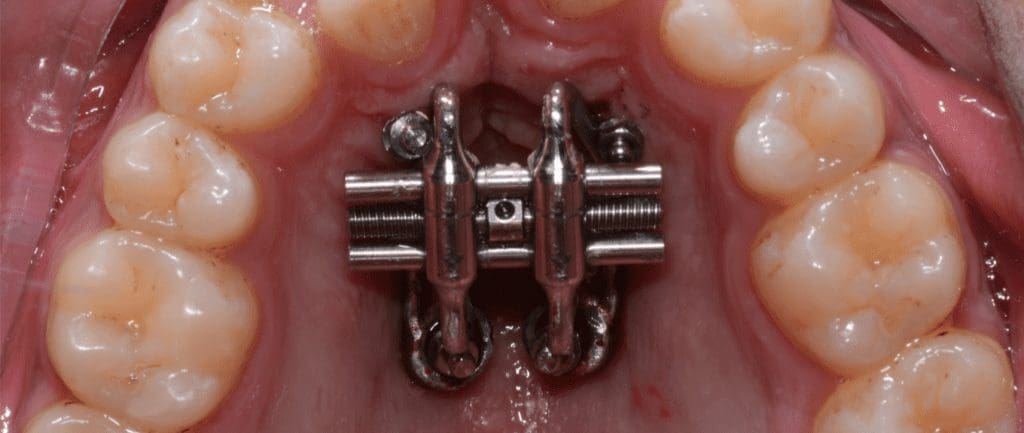
Experienced operators treated the at four centres, and operators used the same expansion device. This incorporated four mini-screws and one expansion screw, without dental or resin anchorage. They activated the appliances by turning the screw until the the achieved sufficient expansion.
The primary outcome was MARPE failure. The team defined this as the clinical absence of mid-palatal suture opening, indicated by the absence of an interincisal diastema.
They collected data on gender, age, multiple CBCT predictors, and bone quality.
They carried out the usual univariate statistical analysis, followed by logistic regression to identify predictors of expansion failure.
What did they find?
The study included 69 patients. These were divided into 38 males and 31 females, with a mean age of 23.5 years. Of these, 39 were treated at the principal centre, and 12, 9, and 9 were in the other three centres.
The overall failure rate was 33%. By gender, the failure rate was 50% in males and 13% in females.
They used their regression model to generate predictors of the failure rate. This showed that the failure rate was higher in males and increased with age, whereas this trend was not observed in females. It was interesting to see that the probability of failure for males was approximately 50% at 22 years, whereas for females it remained 20% across the entire age range.
Importantly, the suture maturation evaluation did not show any significant effect.
Their overall conclusions were
“The effectiveness of MARPE decreased with increasing age in late adolescents and adult patients. The failure rate appeared higher in male patients after age 22. The failure rate reached 50% and continued to increase with age”.
What did I think?
There is no doubt that this technique and other forms of expansion need high-quality research. As a result, it was good to see this excellent exploratory investigation. It is also important to note that this is a prospective study and is a higher level of evidence than retrospective studies.
The results are interesting and clinically useful. They certainly do not align with the claims made by case reports. Other systematic reviews and retrospective studies also suggest an 80% to 90% success rate with MARPE. Nevertheless, these reviews have included mostly retrospective studies. This study clearly adds to our knowledge by providing higher-level evidence.
The authors highlighted several limitations. I think the most important is their definition of failure, which was limited to the absence of a midline diastema. Importantly, they did not obtain an end-of-treatment CBCT to assess palatal suture opening. However, I doubt that this would have been ethical. In this respect, I feel that the outcome was clinically relevant, and we should consider this valid.
I would also have liked to see some information on success rate by operator or clinic. This is important because there was an imbalance in numbers between the clinics, and this may suggest that the operator who placed 39 appliances may be more experienced than those who placed fewer. This may, of course, influence the success rates, particularly if one of the low-output clinics treated more older males than the others.
Final thoughts
This study has some minor deficiencies, but it provides us with useful information, particularly with respect to the effects of age and potentially gender on the success rates of MARPE. As a result, it provides us with useful data that we can share with our patients when we obtain their consent to this form of treatment.

Emeritus Professor of Orthodontics, University of Manchester, UK.
My problem with your blogs, Dr. O’Brien, is statements like this: “Expansion gurus heavily promote this treatment and claim 100% success rates.”
While you require properly designed studies with evidence to support their conclusions, when it comes to MARPE, airway, Invisalign, or anything you don’t like, you frequently list straw man arguments that lack proper sourcing.
If you are going to make that statement, there is a requirement to state who is making that claim. What exactly are they claiming? Cite your sources. Enough creating these “guru claims” while wildly exaggerating statements that people may or may not have made.
I do not use MARPE, but I just took a course where they made it very clear that it is less effective in men and that success rates decrease with age. I have heard dozens of speakers, many paid by Invisalign, discuss the limitations of tooth movement effectiveness. I don’t do sleep studies or “airway orthodontics,” but I have always understood from airway speakers that tonsillectomy and/or CPAP are the gold standards, and that expansion and sleep appliances are secondary to these modalities.
So please stop making statements that are unattributed and may not even exist. Hold yourself to the same standards with your own claims that you hold the studies you evaluate.
You are an extremely intelligent orthodontist, but the bias in your commentary toward those you dislike, based on claims you attribute to them without evidence, is tiring.
Thanks, I’ll take your point on board. I have changed the text in this post.
I read this and am left with thoughts of all the things not considered.
On the positive side, it is good to see a prospective study on MARPE where age and sex is taken into account. Good science appropriately applied is a welcome respite in our current environment.
On the other side, there are so many things that still need to be considered beyond success or failure when related to age. First and foremost is to consider what happens not just with the failures. We need to consider the types of complications that can accompany those failures. How do complications compare with both increasing age and with gender? Inquiring minds want to know.
Going even further, most research showing complications only looks at the most common and most benign complications when they look at incidence rates. Things like gingival swelling and Mini screw deformation are amongst the most common. They also seem the most benign and reversible.
However, let’s consider the more significant complications such as severe asymmetric expansion (sometimes with one side not expanding at all), significant deformation of the occlusal plane, vomer fracture, orbital fracture and corresponding effects upon vision, etc. While these are all documented, the potential increased risk of these complications increasing with age and sex is seldom considered.
Considering the shared article, and the factors not considered, I again find it interesting that in the JCO survey on this particular topic, there were two respondents for whom there was no upper age limit at which they would not use MARPE. All things considered, this does seem a shocking perspective.
With regard to a final CBCT not being taken for this particular research, there is other research looking at just occlusal PAs, pre- and post-treatment. They looked at the ratio of expansion of the appliance and the suture on the PA, pre- and post-treatment. This seems more accurate than looking just for a midline diastema. In that other research, there were also decreasing results with age as well as a gender difference. It is disappointing that the authors of this article did not also use this simple, low-dose means of assessing success with regard to age and gender. Still, it is refreshing to see good research on the topic.
Thanks for sharing.
A MARPE that is not connected to the teeth, has only 4 screws, and was not assisted with any type of assist in terms perforating or cutting bone with a Piezo device is very likely to have a high failure rate in 20 something males. I can attest to this from personal experience. Also, the type of expander, the diameter of the screw and the rigidity of the framework are all factors that can be modified to increase the chance of success. Different bone thickness and density requires different appliances. Those options exist here in the U.S. and produce a much higher success rate (at least for me) than what was shown here. (Note: I will read the article, but for those who don’t, if you could provide a photo of the expander that was used by the researchers in the blog post, I think it would be helpful to understand the outcomes). And as always, thanks for continuing to put out this excellent Blog, (which I will continue to support each year with a donation when asked, as I hope anyone else who reads this does as well)