Exploring maxillary expansion: A useful look at MARPE and RPE outcomes
Readers of this blog will know that I have been calling for good clinical research into how expansion affects the airway. This is because orthodontists are using expansion to solve airway issues without enough evidence to prove its effectiveness. Although there are several expansion methods, the one that shows the most promise seems to be MARPE.
In a previous post Martyn Cobourne analysed the methods of expansion and concluded:
“There are few high-quality RCTs, significant heterogeneity between studies, and limited long-term follow-up. We may achieve Maxillary skeletal expansion using various appliance designs and protocols, but MARPE appears to be the future. However, first, there is a need for high-quality clinical trials to further investigate and refine these appliances”.
This new trial was a promising initial step in addressing this shortcoming.
A team from Jacksonville and Boston did this study. The Angle Orthodontist published the paper.
What did they ask?
They wanted to ask this question:
“What are the differential changes in nasal patency and dentoskeletal morphology after maxillary expansion using either a conventional tooth-borne (TB) RPE Hyrax appliance or a tooth-bone-borne (TBB) hybrid MARPE appliance in late adolescents and young adults”.
What did they do?
They did a two-arm RCT with a 1:1 parallel allocation.
The PICO was:
Participants
Orthodontic patients with skeletal maxillary deficiency with a bilateral crossbite, with a cervical maturation at stages 5-6 and aged 16-21.
Intervention
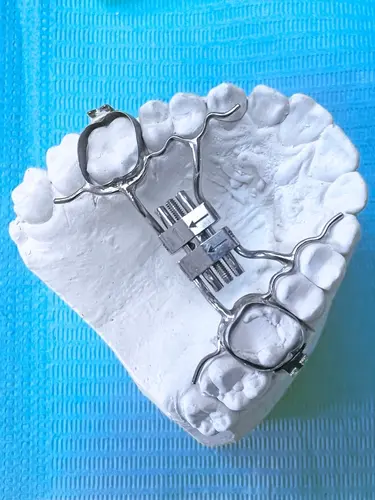
Treated with a TBB-borne hybrid hyrax appliance with molar bands and two 1.7x8mm miniscrews placed distal of the third palatal rugae midsagitally.
Comparator
RPE group, these patients were treated with a conventional tooth-borne Hyrax appliance.
Outcomes
The primary outcomes were nasal airflow and nasal airway resistance at the start and the end of treatment.
The team recorded this data using a clinical rhinomanometer and a face mask. Other outcomes included skeletal and dentoalveolar changes for the groups, measured by analysing CBCT images taken at the start and end of treatment.
One orthodontist treated all the patients, and the expansion screw was activated at a rate of two quarter turns per day (0.4 mm). They ceased activation when the lingual cusp of the maxillary first molar aligned with the buccal cusps of the mandibular first molars.
The team carried out a clear sample size calculation, which indicated that they needed seven participants in each group. They used a pre-prepared randomisation. However, I could not find any information on allocation concealment.
They carried out the relevant statistical analysis. Importantly, they only included an analysis of the participants who experienced successful sutural opening. I have contacted the author about this, and they informed me that, for ethical reasons, if a suture did not open, they treated the patients with SARPE. This is entirely acceptable.
What did they find?
They randomised 15 participants to each intervention. There were no differences between the groups in terms of age or sex distribution; importantly, there were no differences in the rhinomanometry parameters before treatment.
An important finding was that 13 of the 30 participants did not achieve sutural opening. There was no difference between the two groups regarding suture opening. The success rate for the MARPE group was 53%, and for the RME group, it was 60%.
When they examined the change in and posterior nasal airflow, the results were -63.75 ± 128.61 cm³/s for the RPE group, and for the MARPE group, the results were 138.74 ± 78.38 cm³/s. This difference between the groups was statistically significant.
When they examined the posterior nasal resistance, they found that in the RPE group, it was 0.49±1.65 Pa s/cm³, and in the MARPE group, it was -1.01±1.49 Pa s/cm³. This difference was not statistically significant.
Finally, the MARPE group showed greater expansion in nasal, maxillary dentoalveolar widths compared to the RPE group. While, these differences were statistically significant. They were mainly in the order of 1 mm.
Their final conclusions were:
“In adolescent and young adult orthodontic patients, they observed similar results for successful sutural opening with MARPE or RPE. Furthermore, MARPE resulted in greater changes in nasal patency and skeletal maxillary expansion compared to conventional RPE”.
What did I think?
This was an interesting small study. Notably, it was quite complex and ambitious, and it is precisely the type of research that should be conducted into the effect of orthodontic treatment on breathing.
There were several significant findings. Firstly, the success rates for suture opening were low. This meant that the data were collected from a small sample. Consequently, we must consider this as a pilot study. Nonetheless, it remains valuable, as it highlights directions for future research and offers information for sample size estimation and methodology refinement.
The authors discussed this low success rate in their discussion. They explained that it is mainly due to the single screw design and mono cortical engagement of the appliance. They noted that higher success rates have been reported with bicortical screw placement in other retrospective studies. This finding should also be considered when planning a future trial.
They also highlighted that a limitation was the lack of nasal cavity evaluation by ENT specialists. This input is probably necessary in a larger study.
Final comments.
Some readers of this paper and my review might be overly critical of the study design. However, I disagree and believe that this research team should be congratulated for conducting one of the first pilot study trials into this treatment. As I have mentioned before, this kind of research has been long overdue, and I cannot understand how those advocating these treatments are not conducting trials to assess their effectiveness.
I fully recognise that these studies are complex and costly. However, small pilot trials are an essential initial step in the research process for most clinical interventions in medicine. Therefore, this study is highly valuable. It is time for a study team to utilise the findings from this study,

Emeritus Professor of Orthodontics, University of Manchester, UK.
I think this type of studies MUST have a follow-up examination since any maxillary expansion is fraught with a relapse.
Another timely commentary, Kevin – thank you. I notice the article says in the 30 patients evaluated, 13 experienced failure of palatal suture opening, including 7 (4 females and 3 males) in the MARPE group, and 6 (one female and 5 males) in the RPE group. It then says “The success of suture opening was 46.6% and 60% in the RPE and MARPE groups, respectively”. The numbers don’t add up?
Maybe I’m missing something, but it appears that suture opening was successful in 60% in RPE and 53.4% in MARPE groups, respectively. Please correct me if I’m wrong. I would also like to know, in the cases where the suture didn’t “open”, was there widening of the palate, etc. or where these cases excluded from the results? If the palate did widen in cases where the suture did not “open”, what was the mechanism for this? I think the bigger point is that suture “opening” is a euphemism. “Opening” a suture is violating biologic boundaries, resulting in an iatrogenic fracture. Fortunately, sutures provide a niche for mesenchymal stem cells that undergo signal transduction, forming osteoprogenitor cells that differentiate into bone forming/remodeling cells that provide a mechanism for wound healing. In addition, the risks, benefits and alternatives to MARPE need to be considered since techniques like MARPE can produce unintentional fractures elsewhere (e.g. pterygomaxillary disjunction). Here’s a commentary I wrote on this topic recently.
Singh GD. Customized MARPE: Risks, benefits and alternatives. J Clin Images Med Case Rep. 2025; 6(10): 3806.
Disclosure: Professor Singh is the inventor of in the DNA appliance, the first palatal expander to be FDA cleared for the treatment of mild, moderate and severe OSA in both children and adults.
Hi Dave, quick reply about the numbers and I will get back to you later about the other comments.
The numbers in my blog are correct.There is a type in the advance access paper. I have checked this with the author and the percentages that I have included in my post are the correct ones. The paper will be changed in due course.
Best wishes Kevin
We conducted a very similar trial in preadolescents with almost identical results.
Effects on nasal airflow and resistance using two different RME appliances: an RCT. EJO, 2018.
Now there are two RCT:s indicating similar results, in different age groups.